
Releases from the Jim Hogg Temporary Processing Facility
This facility was a temporary state Operation Lone Star booking and processing center for border-related arrests. It was separate from the ordinary Jim Hogg County Jail. State descriptions of people moving “in and out” of the center refer to processing through a justice system, not necessarily release to the community.
A person leaving the processing population could move to a county jail, an Operation Lone Star detention unit, court, another custodian, or the community. Therefore, the key record is not a bare departure count. It is the individual chain showing the arresting agency, booking or cause identifier, departure action, receiving facility or agency, and court case.
How to Confirm a Jim Hogg Processing-Center Departure
No public live roster or historical release tool was established for this temporary operation. Start with the documents already in hand and identify the county or state agency attached to the case.
- Confirm that the source names the temporary Operation Lone Star center, not Jim Hogg County Jail.
- Record the full name, birth information, arrest date, arresting agency, booking identifier, and cause number.
- Ask the arresting or prosecuting county where the person was booked after processing and which court received the case.
- Request the booking, transfer, or release entry that identifies the next destination.
- Check the criminal docket and signed orders in the county of prosecution.
- If TDCJ, another jail, USMS, or ICE appears as receiver, use that custodian's official system.
This chain prevents a large-system statistic or a processing-center mention from being mistaken for an individual release record. The Jim Hogg County released inmate records guide explains how county, state, federal, and immigration sources differ.
Jim Hogg Temporary Facility Status Must Be Verified
Texas Commission on Jail Standards minutes discussed renewal and compliance review, while reporting in March and April 2025 said the state would close the center. The available research did not establish a precise final operating date through a newer direct state inventory. The responsible description is historical or status-to-verify.
Do not send a family member there as though it were a current county jail. Confirm present status with the responsible state or county office before travel or records routing. A report announcing closure and a later final closure record are not identical. This page therefore does not assert a closure date that the source set could not verify.
Historical reports can explain the center's function, but current custody requires a present response from the actual custodian.
Operation Lone Star Was Not an ICE Facility
Operation Lone Star arrests at this center belonged to the Texas state criminal-justice process. The Governor's announcement, the Texas Senate interim report, and jail-standards records establish that state role. A migrant processed there was not necessarily in ICE custody, and the center must not be labeled an immigration detention facility.
Immigration custody can still arise later in an individual chain. If an official transfer record names ICE, check the ICE Online Detainee Locator and compare its result with the transfer destination. No active ICE facility or verified ICE contract was found inside Jim Hogg County. A locator no-result can reflect spelling, identifiers, timing, eligibility, or another custodian, so it does not by itself prove release.
Jim Hogg Processing Counts Are Not Release Statistics
The Texas Senate report gave a collective figure for people processed through the Jim Hogg and Val Verde centers. That combined system figure is not the population of Jim Hogg County Jail, is not a count for this center alone, and is not a count of community releases. It should never appear in a “released inmates” total.
Processing volume describes administrative flow. Individual release verification requires a named person's event record. Even an accurate count of people leaving a processing center would mix transfers, court movements, and possible community departures unless the source classified each destination. The source set does not support that conversion.
| Statement | What it can establish |
|---|---|
| Processed through the state centers | System activity, not community release |
| Left the Jim Hogg processing population | Departure from that processing stage only |
| Transferred to a named jail | Continued custody with a receiver |
| Released by order or bond | Basis for departure, subject to other holds |
| Custodian record shows community release | Release from that named custody event |
Records and Contacts for a Jim Hogg OLS Case
The temporary center does not have a verified current public records desk, street address, telephone line, or operating schedule in the research suitable for directing present inquiries. Inventing those details would risk sending a request to the county jail or a closed operation. Route the request by the agency and case instead.
Start with the named case custodian
Local physical-status check: Jim Hogg County Sheriff, 361-527-4140, only when the record may involve the ordinary county jail
Jim Hogg court routing: County and District Clerk, 361-527-4031
State sentenced custody: Texas Department of Criminal Justice offender search and records channels
Other county case: Sheriff, clerk, and court in the arresting or prosecuting county
Ask for the booking or intake record, transfer or release order, receiving agency, and the criminal docket. A source may connect the person to this processing center while the durable case file sits in another rural county.
The State Opening Record Shows the Facility's Distinct Role
The official Governor's Operation Lone Star announcement documents why the Jim Hogg center opened and how the state described its booking function.
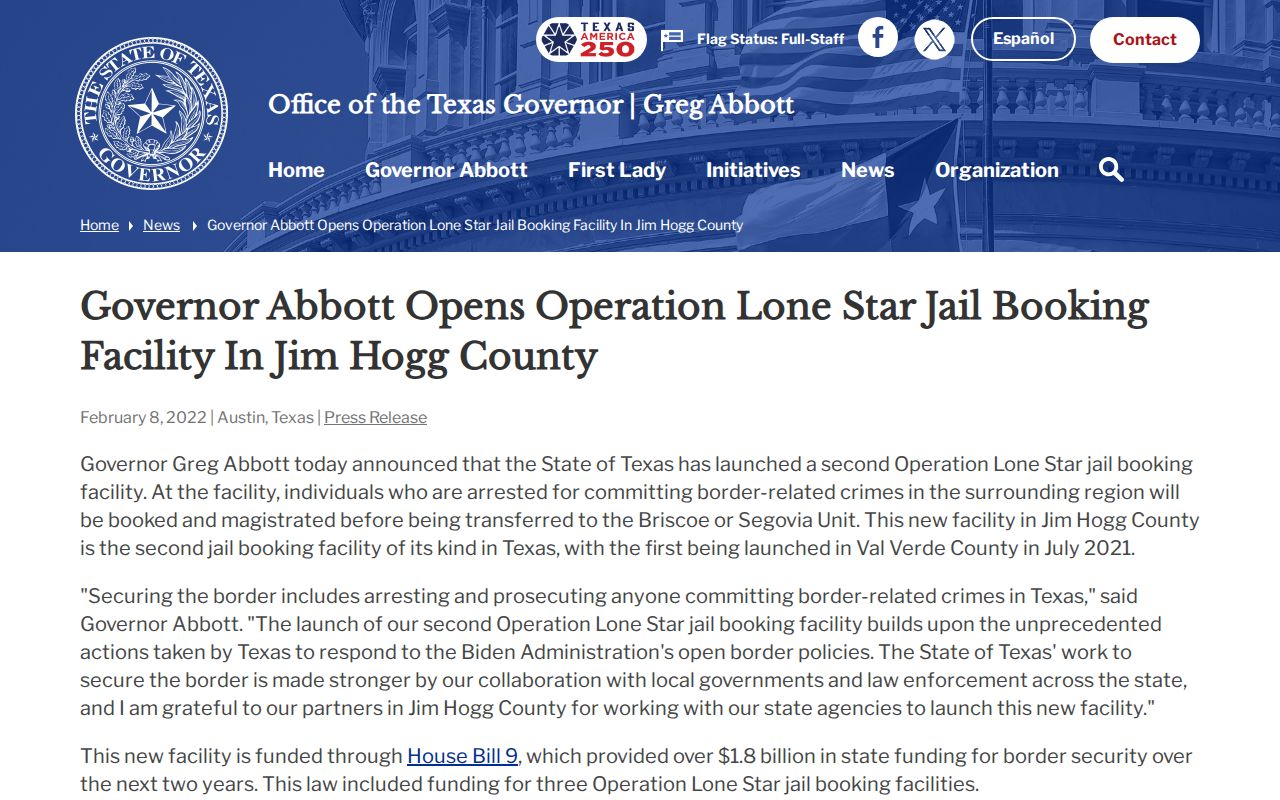
The captured page supports the facility's state-system identity. It does not prove that the center is open now, supply an individual release record, or convert processing into community release.
Jim Hogg County Jail Is a Separate Facility
The Sheriff-operated county jail at 211 E. Galbraith Street is the local pretrial and short-sentence facility. Its records can show bond, dismissal, time served, sentence completion, court-order release, or transfer. Those ordinary county records should not absorb Operation Lone Star processing data merely because both operations were located in Jim Hogg County.
If the source names the Sheriff jail, use the Jim Hogg County Jail release page. If it names the temporary state center, trace the OLS case and destination. Keeping these identities separate is the central accuracy safeguard for this county.
The distinction also controls which record answers the question. A Sheriff jail-register entry can establish departure from the county jail, but it cannot substitute for a separate state processing record. Likewise, an Operation Lone Star report cannot prove an ordinary county booking. Compare the operator, arresting agency, prosecuting county, cause number, departure action, and receiver on each document. When sources conflict, ask each office to explain the event recorded in its own system rather than combining the timelines.