
Sequence Jim Hogg Release Records
A reliable timeline starts with the source that held the person. For a local episode, place the booking entry, signed court order, release or transfer entry, and receiving-agency record in date order. For a state sentence, place the TDCJ calculation, Board action, scheduled fields, release certificate, and later supervision or discharge status in order.
This sequence prevents a common error: treating the first favorable item as the final event. A bond decision can precede processing, a Board vote can precede audit and programming, and a scheduled date can change. The last verified status should come from the agency responsible at that point in the custody path.
Jim Hogg Projected and Actual Release
A projected date is a prospective time-calculation output. TDCJ defines its Projected Release Date as the day Classification and Records calculates that an inmate may leave incarceration if parole does not occur sooner. A scheduled date and scheduled location can appear later, after favorable release action and more processing. The actual release is the historical event recorded after the person leaves the named custodian.
For Jim Hogg County Jail, a bond amount, dismissal entry, court order, or sentence date may explain why release can occur, but none alone proves the door process finished. Another hold can intervene. Ask the Sheriff for release date, time, reason, and destination. If the record says transfer, the person left that jail but remained in custody.
Find a Jim Hogg Projected Release Date
Choose the route by custody system. TDCJ calculations do not apply automatically to a local pretrial case or a county sentence, while the Jim Hogg Sheriff cannot calculate the end of a state prison sentence.
- Identify present custody. For Jim Hogg County Jail, call 361-527-4140. For a TDCJ sentence, use the statewide offender search.
- Match the person carefully. Search TDCJ by first and last name or use the more exact seven-digit TDCJ number or SID. Optional race and gender filters can narrow a common name.
- Read the correct fields. Check unit or supervision status, projected release date, maximum sentence date, parole eligibility, review data, and any scheduled release date or location.
- For a county case, get the judgment. Ask the combined County and District Clerk office for the signed judgment, sentence, jail-time credit, dismissal, or custody order. The Kofile site is a property portal, not a criminal release-date tool.
- Ask the calculating office. TDCJ Classification and Records handles state time-calculation questions. Do not ask the county jail to interpret a TDCJ projection.
- Verify after the date. Use a later TDCJ status, incarceration history, release certificate, or Sheriff release record. A future date that passed without a post-event record is not enough.
The Jim Hogg County released-inmate lookup supplies the broader path when the original custodian is unclear.
Jim Hogg TDCJ Date Fields
The TDCJ public system covers people serving a TDCJ sentence, whether confined or released under TDCJ parole or mandatory supervision. It is not a historical roster of Jim Hogg County Jail. A person who bonded out locally will not appear merely because the arrest occurred in Texas.
| TDCJ field | How to read it |
|---|---|
| Unit or facility | Indicates current TDCJ physical custody. |
| Parole or mandatory supervision | Indicates prison release under an active sentence, not full discharge. |
| Projected Release Date | A prospective Classification and Records calculation. |
| Maximum sentence date | A potential sentence end, not necessarily the physical release date. |
| Parole eligibility | An earliest review point under applicable law, not a promise. |
| Board review or vote | A decision stage that may still require a program, plan, certificate, audit, or scheduling. |
| Scheduled release date/location | Later processing fields that remain subject to change. |
TDCJ says Classification and Records generally audits a case and calculates a scheduled date after it receives a release certificate, a process described as taking about 14 to 21 business days. TDCJ also warns that dates may change without notice, including on the scheduled day.
Note: County of conviction identifies the case source; it does not tell where the person is physically confined or supervised.
Read the Texas Projected Release Screen
The official TDCJ inmate search form is the public starting point for a person serving a state sentence.
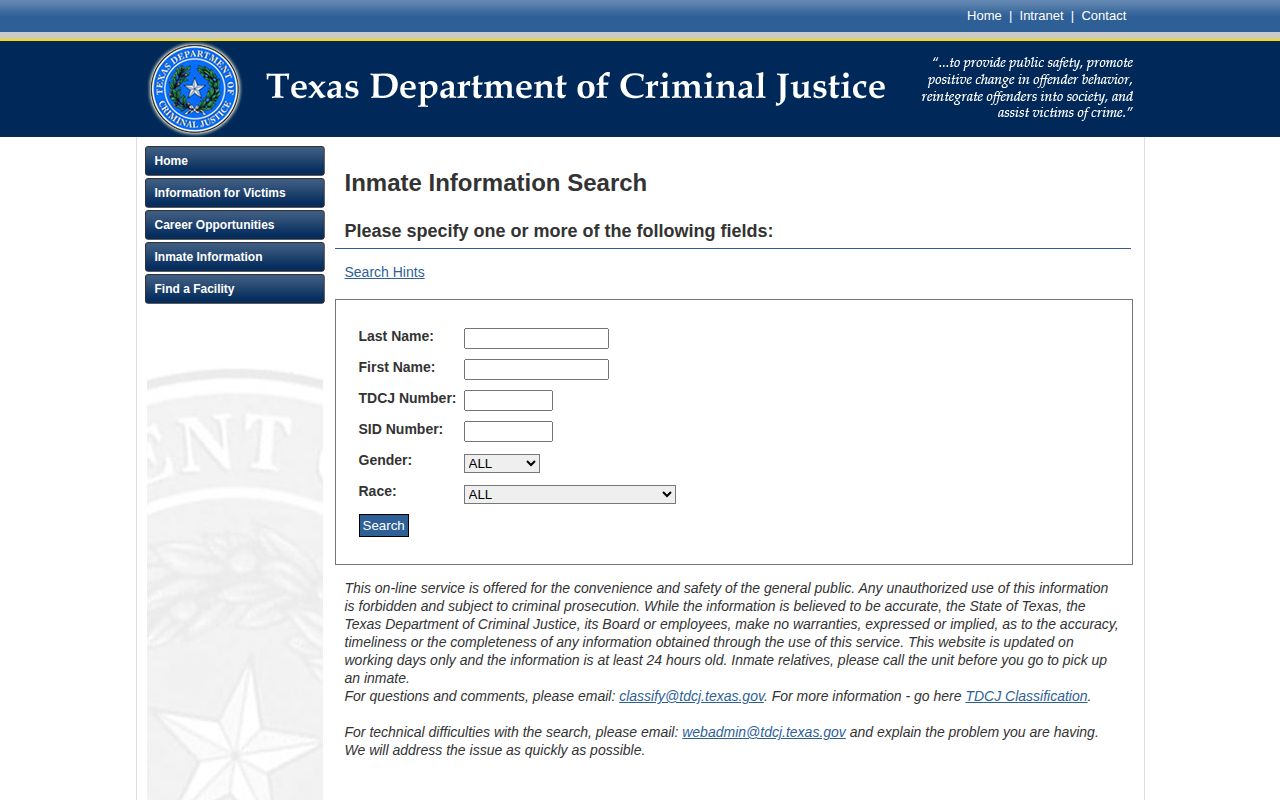
The screen is useful only after the record is matched to the right person. For prior TDCJ history after full discharge, the current web view may not retain a retrievable record, so use the agency's email or formal records route.
Texas Good Time for Jim Hogg Cases
Texas Government Code Section 498.003 makes good-conduct time relevant to parole or mandatory-supervision eligibility and says it does not otherwise reduce the sentence term. It is a privilege rather than a vested right. Classification may change, and credits may be forfeited.
| State classification | Statutory accrual description |
|---|---|
| Trusty | 20 days for each 30 days actually served, with up to 10 additional days. |
| Class I | 20 days for each 30 days actually served. |
| Class II | 10 days for each 30 days actually served. |
| Class III | No good-conduct time. |
| Qualifying programs | Up to 15 additional days per 30 days actually served for diligent participation under subsection (d). |
These are state-system classifications, not a do-it-yourself release formula. Sentence stacking, offense date, offense category, Board discretion, forfeiture, detainers, and audit can change the result. No Jim Hogg county-jail good-time policy was located online, so do not apply the TDCJ table to a county sentence without a documented local policy and legal basis.
No Texas 85 Percent Rule
Texas does not have a universal rule that every prisoner serves 85 percent. Government Code Section 508.145(d) generally requires specified serious-offense cases to reach one-half of the sentence or 30 calendar years, whichever is less, in actual calendar time, subject to the statute's details and minimums. Good time does not reduce that serious-offense flat-time threshold.
Other cases use different formulas, and Section 508.149 identifies mandatory-supervision exclusions. Section 508.147 provides the basic calendar-time-plus-good-time formula for an otherwise eligible mandatory-supervision case. For eligible offenses after August 31, 1996, the Board may deny discretionary mandatory supervision after making the statutory findings. Eligibility still is not release.
Offense date and the exact statute control which framework applies. A maximum sentence date, mandatory-supervision calculation, and parole eligibility date answer different questions. None should be turned into a promise by applying one percentage to the sentence. Use the TDCJ calculation and Board record for that particular state case, then confirm the completed event afterward.
Why Jim Hogg Release Dates Change
A projection reflects inputs and legal decisions that can change. The reason for movement should be traced to the updated agency record, not guessed from the calendar.
| Factor | Possible effect |
|---|---|
| Good-time award or classification | Changes an eligibility or mandatory-supervision calculation. |
| Disciplinary forfeiture | Can move a projection or eligibility point later. |
| Offense date and statute | Determine the governing release framework. |
| Board approval or denial | May move discretionary mandatory supervision between an earlier projection and maximum expiration. |
| Parole prerequisites | A favorable vote may await a program, plan, certificate, audit, or location. |
| New sentence, correction, or audit | Changes the calculation inputs. |
| Detainer or hold | Can prevent community departure even when one sentence permits release. |
| Court order | Can change the sentence or custody authority. |
Confirm a Jim Hogg Release Event
For a pending county custody change, call the Jim Hogg County Jail and ask whether the person is physically held, when the person left, why, and whether another agency received them. For an old local event, request the permanent jail-register entry and the booking or release packet, then pair it with the court judgment.
For TDCJ, email pia@tdcj.texas.gov with the full name and TDCJ number. Without that number, provide the exact date of birth or approximate age and county of conviction. Telephone information is available at 936-295-6371 or 800-535-0283 from 8 a.m. to 5 p.m. Monday through Friday. Time calculations go to Classification and Records, P.O. Box 99, Huntsville, TX 77342, 936-437-6231, or classify@tdcj.texas.gov.
A pending alert can supplement these checks. The Jim Hogg County VINELink inmate search explains county notification coverage, while IVSS is the separate state prison and parole notification layer.
A county sentence requires its own chain. Obtain the signed judgment showing the term and jail-time credit, then ask the Sheriff how that order was applied. Do not substitute a TDCJ projection for a local calculation. A pretrial person has no fixed sentence-based date because bond, dismissal, court action, another hold, and processing can change departure.
Texas retention rules also provide a historical route. The county jail register is permanent. Booking-in and booking-out forms, with commitment, transfer, or release orders, have a minimum retention of release or transfer plus two years. If the event was a transfer, continue with the receiving custodian rather than calling it community release.